Former BYU Football Star Helps Pioneer Breakthrough in Brain Injury Treatment and Recovery.
BY DAN RASCON: , opens in a new tab Anchor, KSL-TV (NBC) Salt Lake City
PROVO — A former Brigham Young University football player and Hall of Famer believes he’s found a groundbreaking solution to the devastating effects of traumatic brain injury — through a new kind of headgear.
The energy, the power, and the teamwork of BYU Football are all part of a program focused on elevating athlete performance. But for Colbey Clawson, BYU’s Director of Sports Medicine and Training, peak performance starts in the brain.
“I tell our players, everything starts in the brain. Movement starts in the brain, strength starts in the brain, speed starts in the brain,” Clawson said.
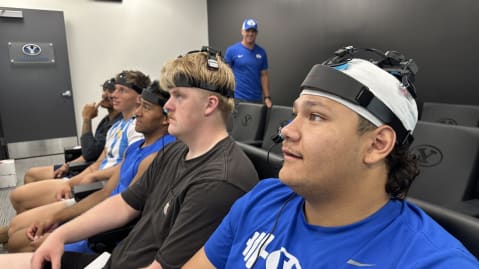
The secret to brain health may lie inside a small, light-emitting device that you put on like a strap. Though it looks unusual — with tiny flashing red lights and even a component that fits in the nostril — it’s showing promising results.
In 2021, BYU participated in a light therapy study using Vielight devices. , opens in a new tab During the study, 32 healthy football players wore the headsets for 20 minutes, three times a week. Half of the participants used working devices, while the other half wore placebo versions. The study measured cognitive performance, brain inflammation, and tissue damage.
The Vielight devices used on the BYU Football players. (Jack Grimm, KSL TV)
Preliminary results showed increases in grip strength, sustained attention, mental speed, reaction time and cognitive control.
“The players that used it consistently, their grip strength actually started to improve through the season,” Clawson said. “Whereas the players in the sham group saw a decrease.”
Though the official results are still pending publication, BYU trainers say the benefits continue.
1 / 3Five of the BYU Football players undergoing the light therapy treatment. (Nathaniel Gillis, KSL TV)
Running back Lucky Finau is convinced.
“I’m a believer. 100%,” he said. “We all were getting stronger throughout the season, and we all felt like we could keep our speed.”
Offensive lineman Weylin Lapuaho was skeptical at first, but now says, “My mental part of the game definitely went light years ahead.”
The idea to use Vielight came from Dr. Larry Carr, an adjunct professor of neurology at the University of Utah. Carr, a former BYU Hall of Famer, suffered a traumatic brain injury and was diagnosed with probable CTE in 2013.
After undergoing light therapy treatment at the VA Hospital in Boston, Carr experienced a dramatic turnaround.
“I went down a dark hole,” Carr said. “I’m fortunate enough that my wife stayed with me and that I’m alive.”
His wife, Laurie, noticed the change quickly.
“He was calming down. He was more peaceful, more relaxed,” she said.
“It had a tremendous change in emotion, cognitive abilities,” added Carr. “I find more peace. I find more purpose.”
Carr said the brain scans of players in the study showed reduced inflammation in players using the devices, while untreated players showed worsening conditions.
“When I left Boston, I turned to my wife and said, ‘I’m going to save football,’” Carr recalled.
Carr brought the idea to BYU Athletic Director Tom Holmoe, who immediately saw the potential.
“When I heard something could possibly help with concussions and football, I said, ‘I’m in,’” Holmoe said.
Brett Mortensen, Director of BYU Football Athletic Training, explained the science behind it.
“The theory is, you get ATP, which is the energy most of your body runs on. There’s evidence of decreased neuroinflammatory response in the brain as the season goes on,” Mortensen said.
For players like Lapuaho and Clawson, the long-term benefits are just as important.
“I want to be able to raise a family, have a wife and kids,” Lapuaho said.
“I want to see them high-functioning years and years down the road,” Clawson added.
Before the BYU study, researchers tested the devices on Las Vegas firefighters and found a 35% decrease in depression and a 40% drop in PTSD. Carr and his team are now exploring studies with Utah NFL alumni.
About Haas Factory Team:
Haas Factory Team is a NASCAR Cup and O'Reilly Auto Parts Series program owned by Gene Haas, founder of Haas Automation. New in 2026, Haas Factory will align with Chevrolet. As part of the manufacturer switch, HFT will have a technical alliance with Hendrick Motorsports, which will include using Hendrick-built engines across both series. The team will feature Cole Custer driving the No. 41 Chevrolet Camaro ZL1 in the NASCAR Cup Series, while Sheldon Creed and Sam Mayer take on the O'Reilly Auto Parts Series in the No. 00 and No. 41 Chevrolet Camaros, respectively. Based in Kannapolis, North Carolina, the Haas Factory Team reflects a commitment to performance and engineering excellence, carrying forward Gene Haas’s commitment to motorsports.
About Vielight
Vielight develops non-invasive neurotechnology based on intranasal-transcranial photobiomodulation (itPBM), a targeted form of near-infrared light therapy designed to support mitochondrial activity, cerebral blood flow, and overall neurological function. Vielight’s patented system delivers light through both intranasal and transcranial pathways, enabling stimulation of deep and cortical brain regions. The technology has been studied in 30+ published research studies and 20+ clinical investigations involving more than 800 participants, including research conducted at Harvard Medical School, University of Utah, Icahn School of Medicine at Mount Sinai, and University of Toronto. Studies have explored effects on brain connectivity, cognition, motor performance, and neuroinflammation. Vielight devices are used by professional athletes, military veterans, and individuals worldwide seeking to support long-term brain health and cognitive performance. For more information, visit https://www.vielight.com.